Low Boost Pressure: Causes, Diagnosis Order, and When the Turbo Is Actually the Problem

Boost pressure is the intake manifold pressure a turbocharger generates above atmospheric, and most modern heavy-duty diesels run roughly 15 to 40 psi under load. When actual boost falls consistently short of what the ECM commands, you have a low boost condition. If your truck feels soft on grades it used to pull easily, or the throttle response has gone flat while fuel consumption creeps up, this is the first thing to check. The cause is usually somewhere in the air path, the boost control hardware, or the exhaust — not the turbo itself. Here's how to tell what's normal, what's not, and where to look first.
What Counts as Low Boost Pressure? (Normal Ranges by Engine)
Boost gets measured two ways, and mixing them up causes half the confusion in forum threads. A mechanical boost gauge reads gauge pressure — the pressure above atmosphere. A scan tool usually reports MAP, manifold absolute pressure, which includes atmosphere (about 14.7 psi at sea level). A scanner reading of 45 psi MAP is roughly 30 psi of boost on a gauge. Before comparing numbers with anyone, make sure you are both reading the same one.
The more reliable check is commanded versus actual. The ECM requests a boost level for a given load and rpm, and any decent scan tool can log both values on a road pull. If actual boost tracks commanded within a couple of psi across the pull, the turbo is doing its job. If it falls consistently short by several psi or more under load, you have a genuine low-boost condition, and the rest of this guide applies.
What "normal" looks like depends on the engine. These are typical stock peak figures on a hard, loaded pull, gathered from field reports and shop data — factory rating, altitude, and intake temperature all move the numbers, so treat them as orientation rather than spec-sheet values:
| Engine platform | Typical peak boost under load (stock) |
|---|---|
| Cummins ISX / X15 | 28 to 35 psi |
| Detroit DD13 / DD15 / DD16 | 30 to 36 psi |
| Cat C15 ACERT (twin turbo) | 35 to 40 psi on standard ratings; 50 to 60 psi on 550+ hp ratings |
| PACCAR MX-13 | 25 to 35 psi |
| Volvo D13 | 25 to 40 psi |
| Mercedes Sprinter 3.0L V6 (OM642) | 15 to 20 psi |
Cruise numbers sit far lower — often 10 to 20 psi on flat ground — so judge boost on a loaded pull, not at highway cruise. This table also settles a question that comes up constantly: is 30 psi a lot of boost? On most Class 8 diesels, 30 psi is an ordinary loaded peak. On a Sprinter, 30 psi would be well beyond stock. On a 625 hp Cat C15 ACERT, 30 psi under load would be suspiciously low. There is no universal "good" number — only what your platform should make.
Low Boost Pressure Symptoms: What You'll Notice First
Low boost rarely arrives alone. Most drivers notice two or three of these at the same time:
- Weak pull under load — the truck feels flat on grades it used to climb easily, and passing takes longer
- Slow spool-up — boost arrives late after a gear change or off the line
- Black smoke under acceleration — the engine is getting fuel it has no air to burn
- Fuel economy drops on the same route, load, and driving style
- A hiss or whoosh under boost — pressurized air escaping before it reaches the cylinders
- Higher exhaust temperatures under the same load
- A check engine light or derate — sometimes. Many low-boost conditions never set a code, because the system is inefficient rather than failed
One symptom by itself proves very little. Smoke with a hiss points one way; smoke with high EGTs and no noise points another. The pattern matters more than any single sign, which is why the diagnosis order later in this guide starts with data, not parts.
The 7 Most Common Causes of Low Boost Pressure (Cheapest to Check First)
The order below follows diagnosis cost, from a loose clamp that costs nothing to a worn turbo that costs the most. It also roughly follows how often each cause shows up in the shop. Work down the list instead of jumping to the expensive end.
1. Boost Leaks in the Charge-Air System
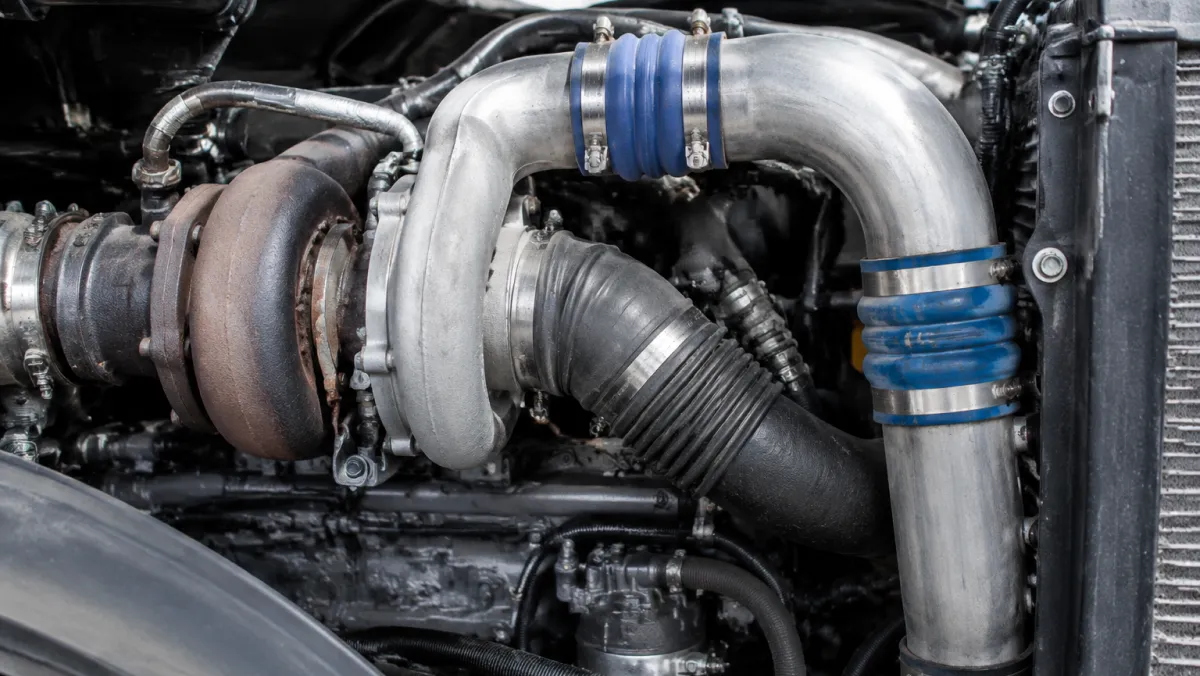
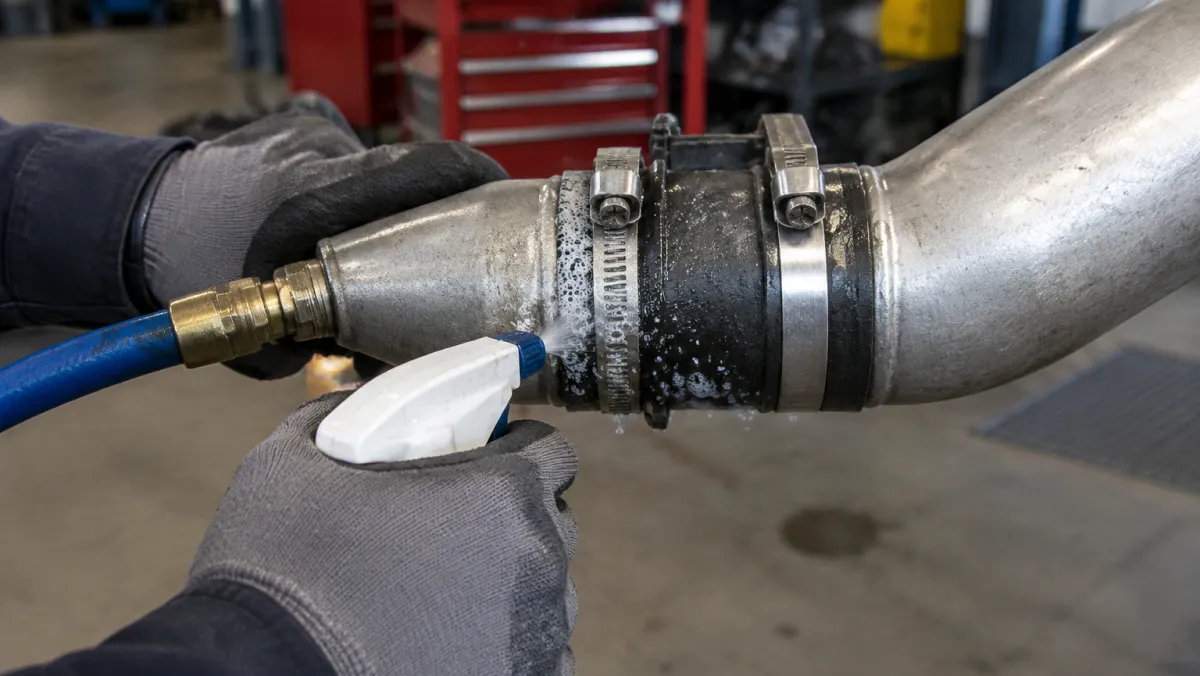
The single most common cause, and it has nothing to do with the turbo. Everything between the compressor outlet and the intake valves is pressurized: charge pipes, rubber boots, clamps, and the intercooler itself. Cracked boots, slipped couplers, blown intercooler end tanks, and loose clamps all dump air before it reaches the cylinders. A pinhole that looks harmless at idle can bleed off several psi at 30 psi of manifold pressure, while the turbo spins harder trying to compensate and EGTs climb. Any joint that lets that air escape is boost the engine never sees. Confirmation is a pressure test — cap the intake, apply shop air, and chase bubbles with soapy water.
2. Restricted Air Filter or Intake
A plugged air filter or a collapsed intake hose starves the compressor of inlet air, and a starved compressor cannot make boost no matter how healthy the turbo is. This one is cheap to rule out: pull the filter, hold it to the light, and look for a dark or oil-soaked element; squeeze the intake hoses and check for soft spots that collapse under suction. An oil-soaked filter deserves a second question — where the oil came from — because it often points at crankcase ventilation rather than the filter itself.
3. Wastegate or Actuator Faults
On wastegated turbos, a pneumatic actuator holds the gate closed against a spring until boost reaches the calibrated level. A weak spring, a leaking diaphragm, or a corroded, sticking rod lets the gate hang open, and an open gate bleeds exhaust energy around the turbine — chronic low boost with a healthy turbo. Many actuators can be bench-tested with a hand vacuum or pressure pump: watch for smooth rod travel and no pressure bleed-down. When a replacement is needed, match the calibrated unit to the turbo part number; the wrong spring rate skews the entire boost curve even when everything else is perfect.
4. Sticking VGT Vanes
Variable-geometry turbos moved boost control into the turbine housing: movable vanes (a sliding nozzle on Holset designs) vary exhaust flow across the rpm range. Soot and carbon gum up the mechanism, and vanes stuck open — or slow to move — produce the classic off-idle low-boost complaint. This is common on Cummins Holset VGT units like the HE300VG and HE351VE, on Powerstroke and Duramax applications, and on most modern emissions-era diesels. Confirm it with a scan tool: command the vanes through their sweep and watch whether position and boost response follow. Sometimes a cleaning and exercise cycle restores movement; sometimes the cartridge is done.
5. Exhaust Restriction (DPF and Piping)
A turbo is only as good as the exhaust flowing through it. A plugged or overloaded DPF, a collapsed catalyst, or a crushed pipe creates backpressure that stalls the turbine wheel and kills boost. Check DPF differential pressure against spec and review regen history — a filter that stops regenerating loads up fast. The pattern here is low power under sustained load with poor fuel economy, and it gets worse as the restriction grows.
6. Sensor Drift (MAP / Boost Pressure Sensor)
Sensors can lie without failing. A contaminated MAP or boost sensor drifts a few psi off but stays inside the range the ECM accepts, so no code sets — yet fueling and boost control now chase a wrong number. On some platforms the fault is almost routine maintenance: the boost sensor fitting on a Cat C15 ACERT carries a small screen that plugs with soot, after which the gauge and the ECM both read fiction. Comparing the scan-tool reading against a mechanical gauge on a test port settles the question in minutes.
7. A Worn Turbocharger
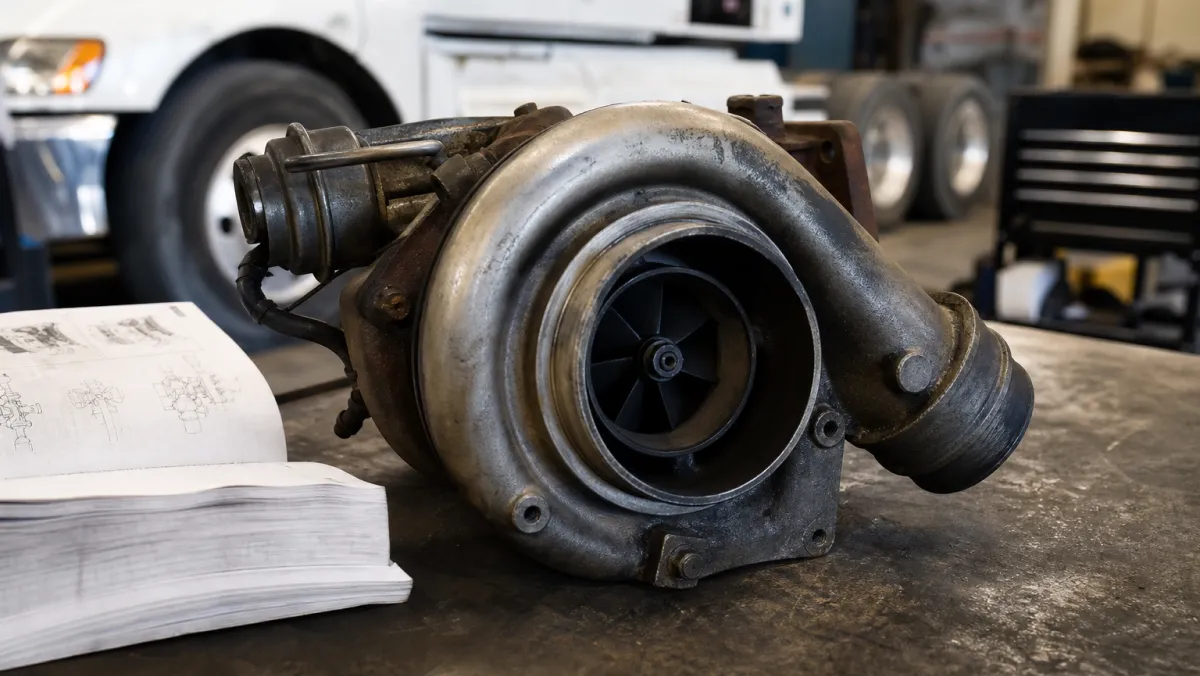
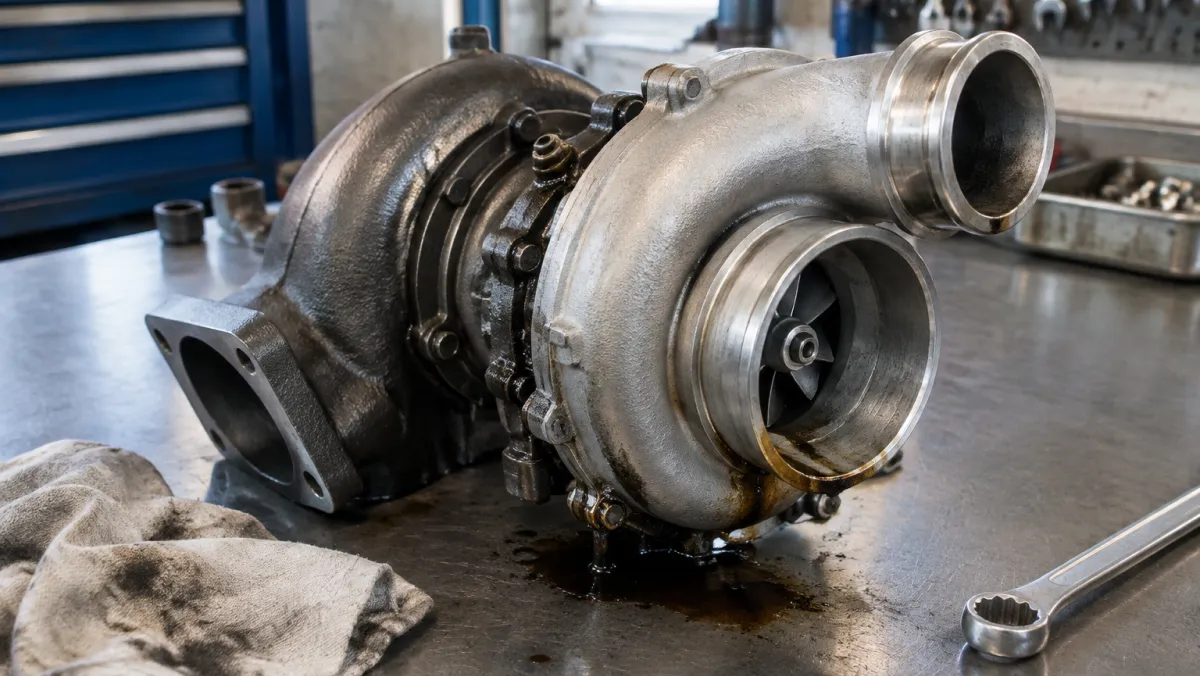
Last on the list on purpose — but sometimes it really is the turbo. Worn journal bearings let the shaft move beyond spec, compressor efficiency falls, and oil starts passing the seals. Pull the inlet pipe and check: radial and end play, rub marks on the housing, chipped or bent blades, oil pooling in the compressor cover. Two cautions belong here. First, oil in the housing frequently traces back to high crankcase pressure or a restricted drain rather than a failed seal — our turbo oil leak diagnosis guide walks that process. Second, an EGR valve stuck open floods the intake with inert exhaust gas, displaces fresh air, and reads exactly like low boost. Confirm the oil side and the EGR before condemning the hardware.
For budgeting, here is how the seven causes compare — how often shops see them, the test that confirms each, and typical repair cost ranges (parts plus independent-shop labor; engine and region will move these numbers):
| Cause | How common | Confirm by | Typical repair cost |
|---|---|---|---|
| Boost leak (boots, clamps, intercooler) | Very common | Pressure test | $0 to $300 |
| Air filter / intake restriction | Common | Visual inspection | $40 to $120 |
| Wastegate / actuator fault | Common | Vacuum-pump bench test | $150 to $600 |
| Sticking VGT vanes | Common | Scan-tool vane sweep | $200 to $1,500 |
| DPF / exhaust restriction | Moderate | Differential pressure reading | $300 to $2,500 |
| Sensor drift | Moderate | Gauge vs scan-tool comparison | $50 to $400 |
| Worn turbocharger | Moderate | Shaft play and wheel inspection | $1,200 to $3,500 (new replacement) |
How to Diagnose Low Boost Pressure: A 6-Step Order
A structured order is what separates diagnosis from parts-swapping. Steps 1 and 2 are within reach of an owner with basic tools; steps 3 through 5 want a scan tool and usually a shop; step 6 is hands-on inspection. Run them in sequence:
- Pull codes and freeze-frame data. Even with no light on the dash, pending and inactive codes — underboost (P0299), DPF pressure, actuator circuits — point the direction before any wrench turns.
- Pressure-test the charge-air system. Cap the intake, apply shop air starting around 5 psi and working up toward normal operating boost, and paint every boot, clamp, and intercooler seam with soapy water. Thirty minutes, and the highest hit rate on this list.
- Log commanded versus actual boost under load. A real road pull with the scan tool recording. A consistent gap of several psi confirms genuine low boost and separates a mechanical fault from a perception issue.
- Check intake and exhaust flow. Air filter and inlet hoses on one end; DPF differential pressure and a look for crushed pipes on the other.
- Test the boost control hardware. Bench-test the actuator on wastegated units; run the vane sweep on VGTs; verify solenoids and control lines.
- Inspect the turbo itself. Shaft play, wheel condition, oil in the housings — only after the path to and from the turbo is proven clean.
Most low-boost complaints are resolved by step two or step three. If yours is not, the remaining steps move from free to expensive in order, and each one either finds the problem or proves a system healthy before money gets spent. Shops run this same sequence for a reason: a pressure test is thirty minutes of labor that eliminates the majority of cases before a single part is ordered.
When the Turbocharger Itself Is the Problem
Only after the air path, the boost control, the exhaust, and the sensors all test clean does the turbo hardware take the blame. The evidence at that point is physical: end play you can feel, rub marks where the wheel has contacted the housing, chipped or bent compressor blades, or heavy oil pooling with crankcase pressure verified normal. Any of these means the unit is done, and it will not recover.
One thing worth knowing before the replacement goes on: journal-bearing turbos are killed by oil problems far more often than by old age — starvation, contamination, restricted drains. Mileage expectations exist, and we have covered how long a diesel turbo typically lasts, but a turbo that dies young almost always dies of something. Find that something first. Every warranty in this industry, ours included, excludes failures caused by oil starvation or contamination, and a new unit bolted onto an unhealthy engine inherits the same failure.
On the replacement itself, there are three honest routes: new, remanufactured, or a professional rebuild of your core. Reman saves money up front but brings the core charge, the return freight, and the paperwork, plus the unknowns of a reused housing. A rebuild keeps your exact casting but takes the truck off the road while it happens. For a working truck, the math usually favors new: no core deposit, no return shipment, no waiting on a rebuild queue. Every unit we sell is brand new with all-new components, high-speed balanced, and leak-checked before packing, and on VGT models we verify the actuator calibration — on the Holset VGT units covered in our Detroit DD15 turbo guide, that calibration step is the difference between a bolt-on repair and a week of boost-curve chasing. Every unit carries a one-year unlimited-mileage warranty, and most orders ship from US stock within 24 hours.
For Shops and Fleets: Sourcing Replacement Turbos
If you diagnose low boost for a living — or across a fleet — the diagnosis is only half the job. The other half is getting the right unit fast, without a fitment surprise. We keep more than 1,000 turbocharger SKUs in US stock covering Cummins, Detroit, Caterpillar, PACCAR, Volvo, Mack, Ford Powerstroke, and more. Send us the part number off the old turbo's dataplate, or the engine serial number, and we cross-reference both before anything ships — the check is free and takes minutes. Repair shops and owner-operators order single units every day at the same warranty; distributors and fleets get volume pricing structured for resale, and white-label packaging is available. For recurring supply, our bulk turbocharger program is built for exactly that.
The shortest path from diagnosis to done: confirm the cause, send us the dataplate number and ESN, and a verified-match replacement ships within 24 hours.

FAQ
The most common cause is a boost leak in the charge-air system — cracked boots, loose clamps, or a leaking intercooler. After that come a restricted air filter, a weak or sticking wastegate actuator, soot-stuck VGT vanes, a plugged DPF, a drifting boost sensor, and finally a worn turbocharger. Check them in that order: cheapest and most likely first.
Usually not. The turbo is the last suspect, not the first. Most low-boost complaints trace to leaks, restrictions, or boost-control faults in the systems around the turbo. Only when the air path, actuator, exhaust, and sensors all test clean — and you find shaft play, wheel damage, or heavy oil pooling — is the turbo itself the problem.
Fix the cause, not the symptom. Pressure-test the charge-air system and repair any leaks first. Then verify the actuator or VGT vanes move correctly, check the DPF for restriction, and confirm the boost sensor reads accurately against a mechanical gauge. If all of that passes and the turbo shows physical wear — shaft play, rub marks, damaged blades — replacement is the fix.
It depends on the engine. On most Class 8 diesels — a Cummins X15, Detroit DD15, or Volvo D13 — 30 psi is a normal peak under load. On a light diesel like the Sprinter 3-0, which runs 15 to 20 psi stock, 30 psi would be far beyond normal. On a high-horsepower Cat C15 ACERT rated for 50 to 60 psi, 30 psi under load would point to a problem. Judge boost against your platform, not a universal number.
You can, but you pay for it. Low boost means incomplete combustion: black smoke, rising exhaust temperatures, poor fuel economy, and faster DPF loading. A short drive to the shop is fine; weeks of hauling in that state risks expensive secondary damage. If boost drops suddenly or smoke turns heavy, stop and diagnose before driving further.
Anywhere from free to a few thousand dollars, depending on the cause. A loose clamp costs nothing; an air filter runs $40 to $120; an actuator or sensor typically lands between $50 and $600; DPF service can reach $2,500; and a new replacement turbocharger usually runs $1,200 to $3,500 for heavy-duty applications. A $30 pressure test is what keeps you from spending the big number first.
A boost leak means the turbo makes pressure but the system loses it — air escapes through a cracked boot, loose clamp, or split intercooler before reaching the engine. A bad turbo cannot make pressure in the first place: worn bearings, damaged wheels, or stuck VGT vanes. A pressure test separates the two in minutes, because leaks show up as bubbles long before the turbo needs to come off.