Turbo Oil Leak: Causes, Diagnosis by Leak Location, and Repair vs Replacement Costs
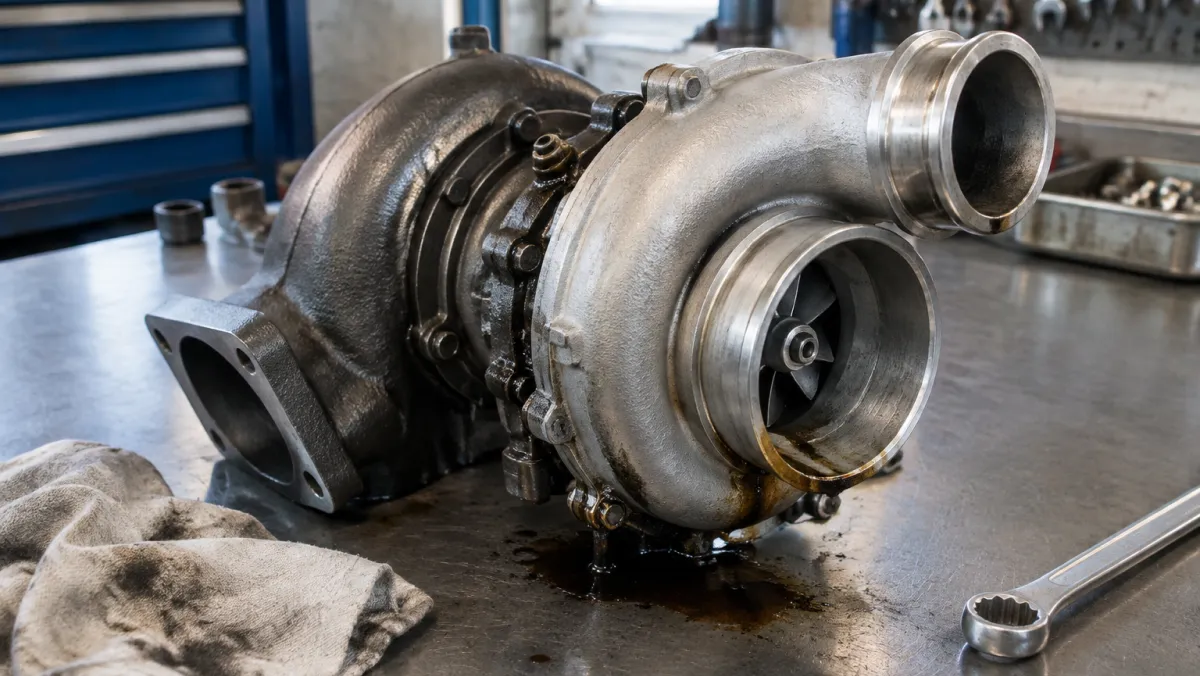
Here's something most drivers get wrong: a turbo that's leaking oil is rarely a bad turbo. In the majority of cases we see, the real culprit is a restricted drain line, excessive crankcase pressure, or the wrong oil — and the turbo itself is fine. Replace the turbo without fixing the root cause, and the new unit will start leaking within weeks. Before you spend money on parts, this guide helps you diagnose the leak by location (compressor side, turbine side, or external), separate normal intercooler residue from an active leak, and decide between a low-cost repair and a full replacement.
Turbo Oil Leak Symptoms — and Whether You Can Keep Driving
An oil leak usually announces itself before it strands the truck:
- Blue or gray exhaust smoke. Smoke under boost points to oil pulled through the compressor side; startup smoke that fades warm usually means oil pooled on the turbine side overnight.
- Oil consumption climbing between changes. A steady rise with no drips on the ground means oil is leaving through the intake or exhaust.
- Oily film inside charge pipes or the intercooler. See the intercooler section below.
- Wet oil around the center housing, heat shield, or downpipe. External seepage at housing joints or line fittings.
- Burning-oil smell, whining noises, weak boost. These show up when the leak comes with real bearing wear.
Turbo seal leak symptoms have one quirk worth knowing: valve seals and turbo seals both make blue smoke. Valve seals smoke on startup after the truck sits; a leaking turbo seal smokes when boost comes on.
Can you keep driving? Two tiers:
- Schedule an inspection this week: light oil film in the pipes, no change in oil level, no smoke. The truck can finish its route.
- Stop and diagnose now: heavy blue smoke under load, oil level dropping between checks, metallic noise from the turbo, or signs the engine is pulling oil into the cylinders. A diesel that ingests enough oil can start burning it as fuel — if rpm climbs on its own, kill the engine.
Oil leaks sit inside a wider family of turbo failure symptoms: small symptoms are cheap, ignored ones are not.
Where Is the Turbo Leaking Oil? Diagnosis by Leak Location
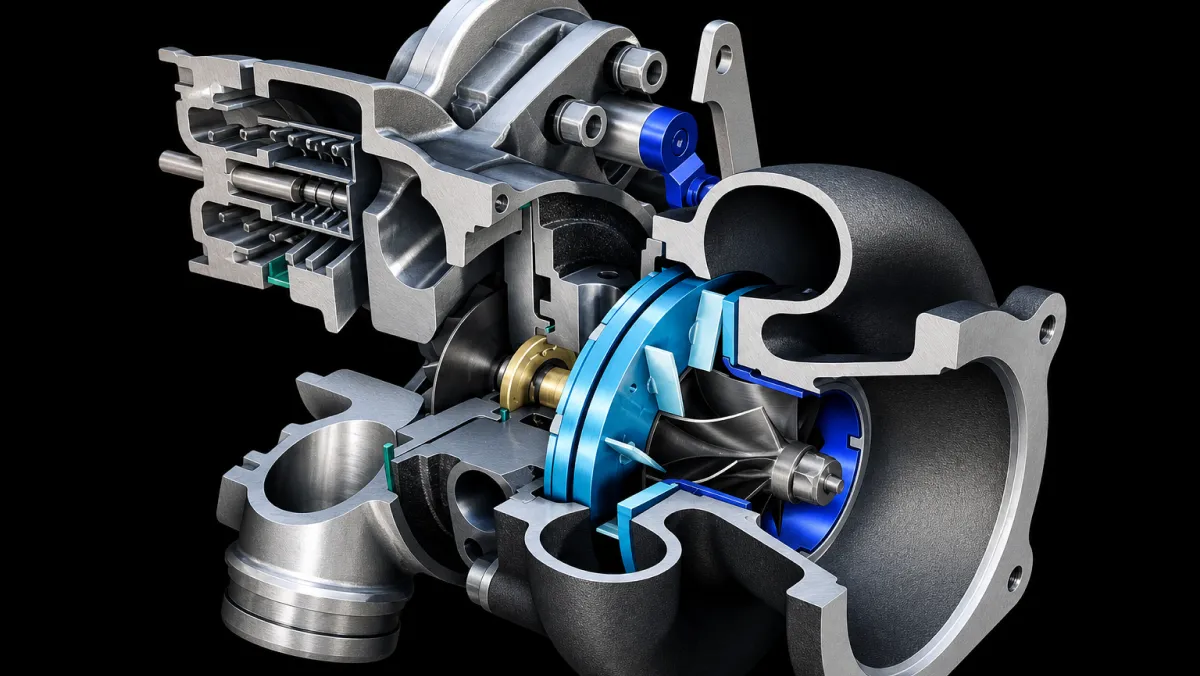
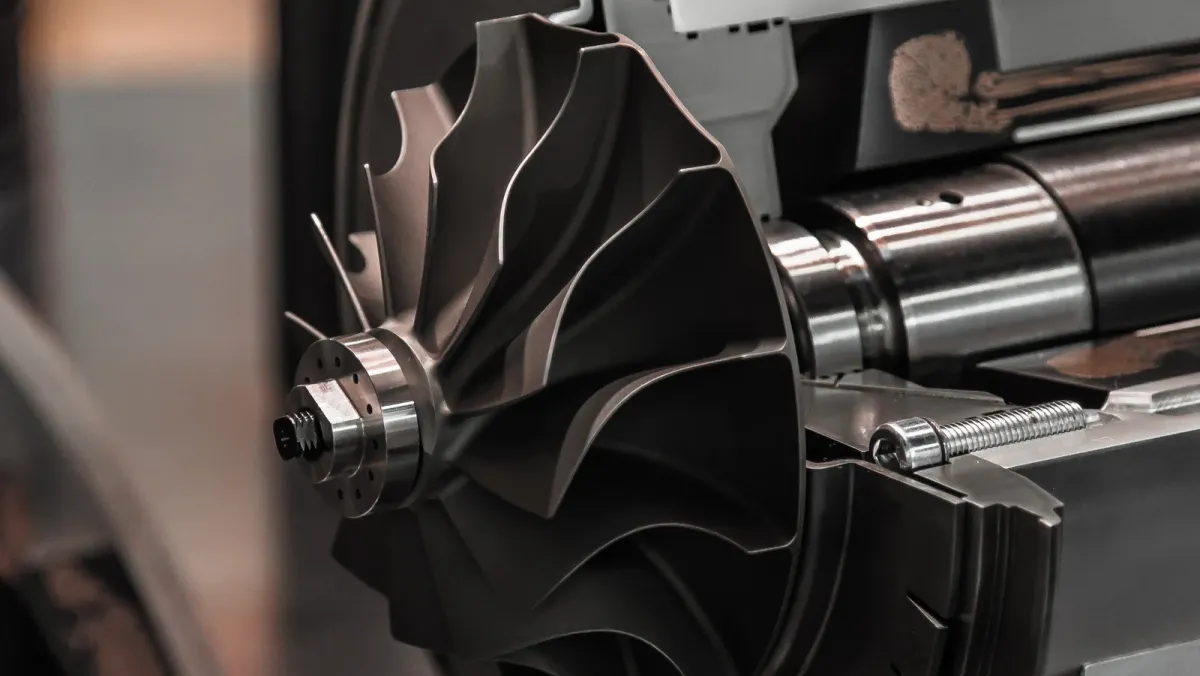
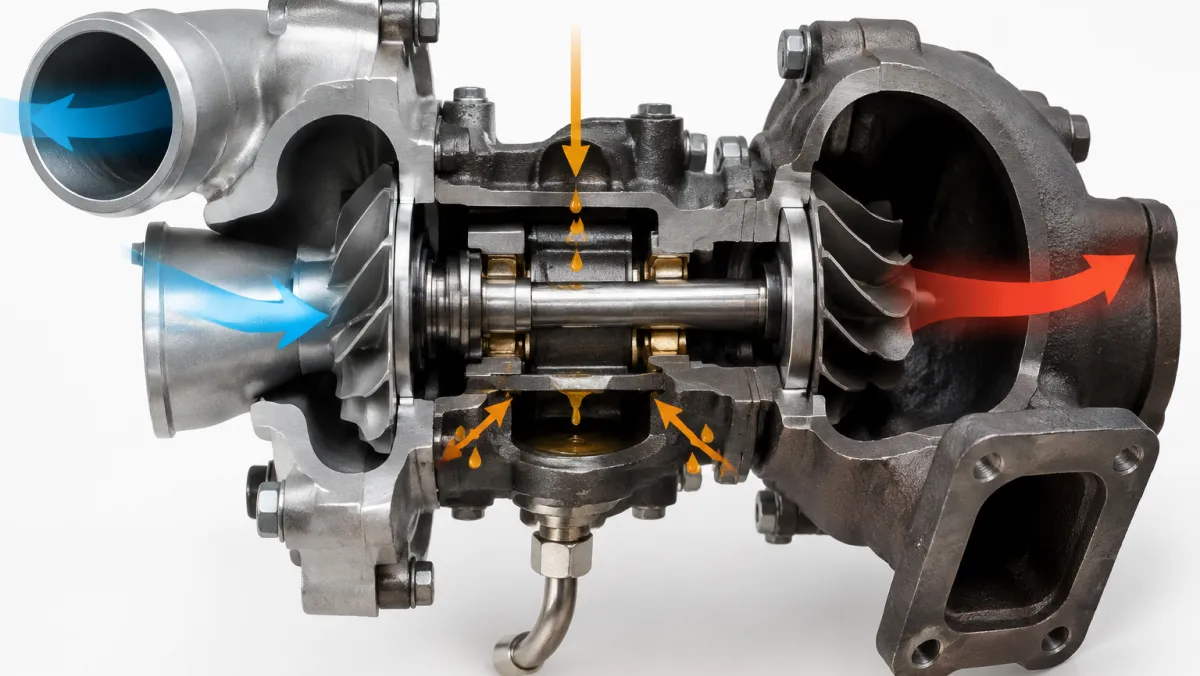
Turbochargers do not seal oil with rubber gaskets around the shaft. They use steel piston rings whose main job is keeping exhaust gas and dirt out of the bearing housing; the oil itself stays in place through gravity, draining out of the bottom port as fast as the feed delivers it. When drainage slows or pressure builds, oil rises to the rings and the spinning shaft throws it outward — that is the leak you see.
Because of that design, where the oil shows up tells you more than how much there is:
| Where you find the oil | What it looks like | Most likely cause | First move |
|---|---|---|---|
| Compressor outlet, charge pipes, intercooler | Oily film or pooled oil in the intercooler, blue smoke under boost | Restricted drain line, excessive crankcase pressure, clogged air filter | Check drain line size and routing, test crankcase pressure |
| Turbine side, exhaust, downpipe | Blue smoke at startup that fades, oil inside the downpipe, carbon on the turbine wheel | Drain restriction, high exhaust backpressure, worn turbine-side ring | Inspect the downpipe, check for exhaust restrictions |
| Center housing exterior | Wet oil at housing joints or on the heat shield | Gasket or O-ring at a joint, loose feed or drain fitting | Clean, re-torque, replace gaskets |
| Feed and drain line connections | Fresh oil right at a fitting | Cracked line, loose fitting, crushed gasket | Tighten or replace the line |
Two notes. External seepage is a gasket job, yet it gets mistaken for internal seal failure more than any other leak. And a leak at both ends at once almost always traces to drainage or crankcase pressure, not two failed seals.
Oil in the Intercooler: Normal Residue vs an Active Leak
Forums argue about this endlessly; the answer is simpler. Every diesel routes crankcase vapor into the intake ahead of the turbo, and over tens of thousands of miles the oil mist in that vapor coats the charge pipes and the bottom of the intercooler. A thin film, or a spoonful of oil drained from the low point on a high-mileage truck, is normal residue.
An active leak looks different:
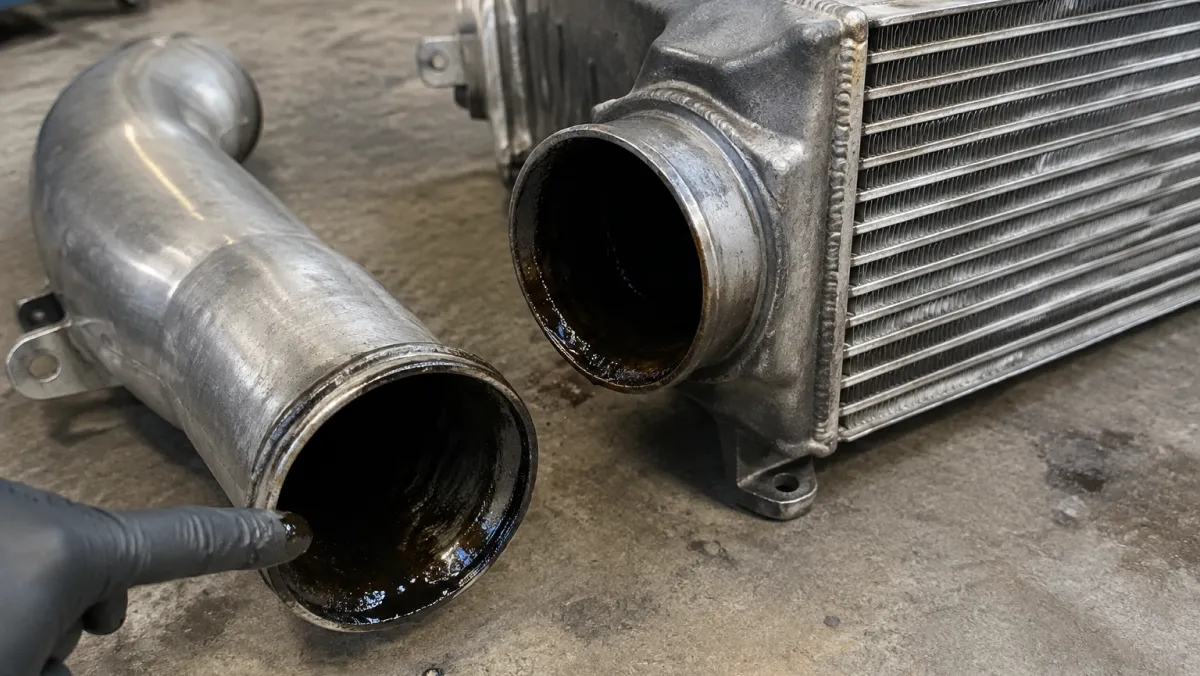
- Volume. Oil that drips when you pull a pipe, or pools in the intercooler end tank, is more than residue.
- Freshness. Clean the pipes, drive a short loaded cycle, inspect again. Wet oil that returns within days is being pushed through now.
- Location upstream. Oil at the compressor outlet with a dry intake ahead of it means the turbo is the path; oil already present before the compressor points at the crankcase vent system.
- Companion symptoms. Rising oil consumption and blue smoke under boost, alongside intercooler oil, confirm an active leak.
Oil coating the intercooler core cuts heat transfer and raises charge-air temperature, and enough oil in the charge stream can feed combustion on its own. Fixing the oil means fixing whatever pushes it there.
Root Causes: A Step-by-Step Inspection Checklist
Work through these steps in order. Most leaks are solved by step six; genuine internal seal failure is the least common cause, so the turbo itself comes last.
- Baseline the oil level. Note the level and miles since the last change. You need a consumption rate, not a guess.
- Inspect the air filter and intake tract. A clogged filter or a crushed, undersized intake tube pulls vacuum at the compressor inlet, and that vacuum draws oil past the compressor-side ring.
- Measure the oil drain line bore. The drain must be at least as large as the drain port in the bearing housing, all the way to the pan. On common heavy-duty frames that works out to roughly a 3/4-inch internal diameter — yet many trucks run a 10AN line bored closer to half an inch. Quick check: a correctly sized drain fitting passes your finger; a fingertip that barely fits means the line is undersized.
- Trace the drain routing. The line should run downhill the whole way, with no 90-degree bends near the turbo, and enter the pan above the static oil level, clear of the crankshaft's splash zone. Check for carbon inside the line — a coked drain is a restricted drain.
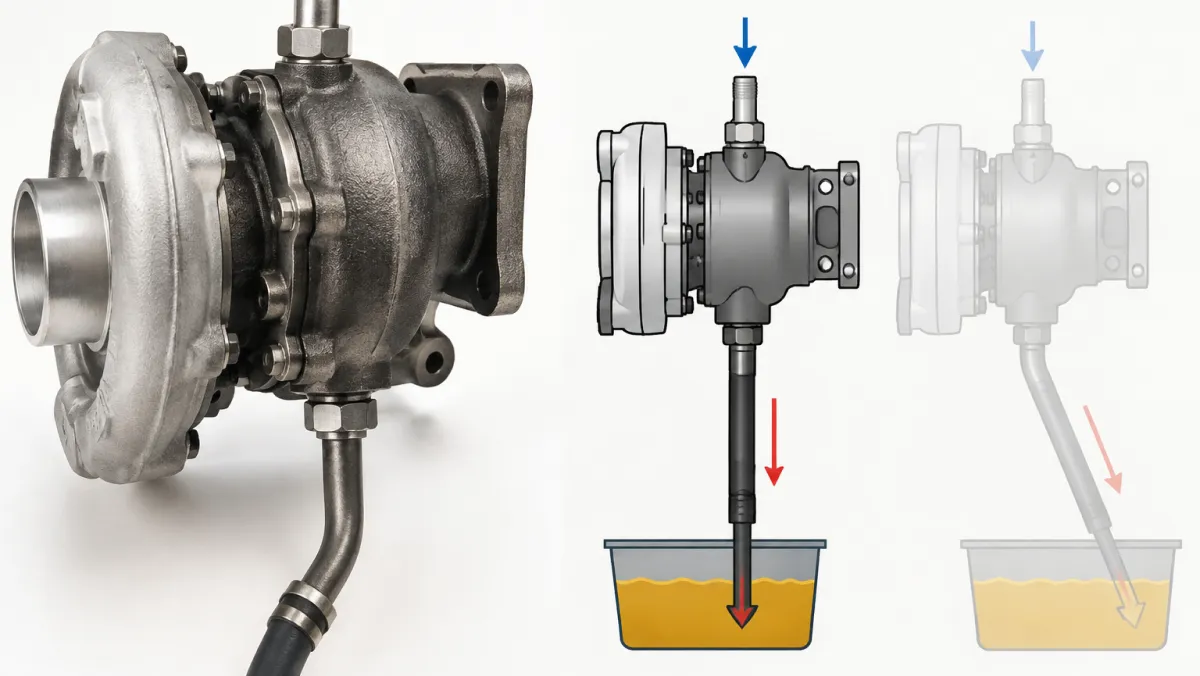
- Check clocking and feed fitting angle. The oil feed belongs at or near straight up; rotated well past 15 to 20 degrees, oil pools on one side of the housing instead of draining evenly. The drain outlet should point essentially straight down — more than about 30 to 35 degrees off vertical and oil backs up. A tilted turbo creates the same problem at the turbine end.
- Test crankcase pressure. Warm the engine, hold a light load, and crack the oil filler cap. On a healthy engine the cap sits still; a dancing cap or pressure pushing out means blow-by is pressurizing the crankcase — and since the drain line ends there, it now works against that pressure. On engines with a crankcase ventilation filter (the 6.7L Cummins is the well-known example), a plugged filter does the same. It is a cheap part; check it before blaming piston rings.
- Review the oil itself. Wrong viscosity, stretched drain intervals, and coked oil passages all show up as leaks. Shutting down right after a hard run cooks the oil sitting in the hot bearing housing, and the deposits slowly choke the drain path. If service history is unknown, change oil and filter to the correct spec first.
- Only now, judge the turbo. Check radial and axial shaft play — slight side-to-side is normal; contact with the housing or real in-and-out movement means wear. Look for wheel damage and heavy carbon in the housing. A turbo that fails these checks needs replacement; one that passes them needs its root cause fixed.
Repair or Replace? Costs, Labor, and the Decision Line
Whatever the repair turns out to be, fix the root cause first. Across the industry, ours included, a new turbo's warranty excludes failures from blocked oil lines, contaminated oil, or intake debris. A replacement installed over an active root cause becomes an out-of-warranty repeat failure.
Typical US market ranges for the common fixes (actual quotes vary by engine and region):
| Fix | Typical parts cost | Typical labor | When it applies |
|---|---|---|---|
| Crankcase ventilation filter | $50–$150 | Under 1 hour | Blow-by pressure from a plugged filter |
| Oil drain or feed line | $100–$300 | 1–2 hours | Undersized, kinked, or coked line |
| Housing gaskets / O-rings | $20–$80 | 1–3 hours depending on access | External seepage at joints |
| Turbocharger replacement, heavy-duty | $800–$2,500+; VGT models with electronics often $1,500–$4,000 | 3–6 hours | Confirmed internal wear |
Shop diagnosis typically runs one to two hours at truck rates — usually the best money in the job.
The decision line is simple. Repair when the shaft is tight, the wheels are clean, and the leak traces to a line, filter, or pressure problem. Replace when shaft play, wheel damage, or heavy internal carbon confirms wear — after the root cause is corrected. For the money side of that decision, see our full replacement cost breakdown; the rebuild option is covered in our rebuild vs replace guide. If replacement is the answer, match a unit by part number in our Cummins turbocharger catalog.
Preventing Turbo Oil Leaks on Fleet Trucks
For a fleet, the cheapest turbo leak is the one that never starts. Five habits cover most of it:
- Cool-down discipline. After sustained hard running, idle a few minutes before shutdown so the housing sheds heat; on twin-turbo setups this matters twice as much.
- Crankcase ventilation filters on schedule. Treat them like fuel filters: replace at the OEM interval, not when a symptom appears.
- Oil spec and intervals, enforced. Correct viscosity, no stretched drains. Coking is a maintenance-schedule problem before it is a turbo problem.
- Drain lines at every turbo-adjacent service. Any job that opens the charge-air or exhaust side should include a drain-routing check.
- Track consumption per unit. A slow rise in oil use across your records is the earliest leak warning you will ever get.
Fleets that run this checklist still lose a turbo now and then — the point is to lose them to honest wear at high mileage, not to a $60 filter. For operations that stock ahead, our wholesale program for bulk replacement units keeps spares on the shelf at volume pricing.
If the checklist points to a worn turbo, send us the part number off the old unit's dataplate. We will confirm fitment before you order, and the replacement goes out from US stock — most orders process within 24 hours. Every unit is brand new with no core charge, covered by a one-year unlimited-mileage warranty. Fix the cause, bolt on the turbo, and the leak stays fixed.

FAQ
Oil that gets past the compressor-side ring enters the intake and burns in the cylinders — blue smoke under boost, rising oil consumption, and an oil-coated intercooler that cools less effectively. Oil on the turbine side burns on hot exhaust surfaces and leaves carbon that can restrict the turbine over time. Left alone, a bad enough leak can escalate to oil-fed combustion and, in severe cases, engine runaway.
Light seepage with no smoke and no change in oil level can usually finish its route while you schedule an inspection. Heavy blue smoke under load, a dropping oil level, metallic turbo noise, or any sign the engine is ingesting oil means stop now — a diesel can begin burning its own oil as fuel, and that situation can destroy the engine in minutes.
It depends entirely on the cause. A crankcase vent filter runs about $50 to $150 and under an hour of labor. A drain line replacement typically lands at $100 to $300 in parts. Gasket jobs are cheap in parts and vary in labor. If the turbo itself is worn, a heavy-duty replacement unit typically runs $800 to $2,500 or more plus 3 to 6 hours of labor. An hour of paid diagnosis usually decides which number applies.
Turbo shaft seals are steel rings that rely on gravity drainage and pressure balance, and oil gets past them when that balance breaks: a restricted or undersized drain line, an incorrectly rotated feed or drain fitting, excessive crankcase pressure, a clogged air filter, or — least commonly — worn internal parts. The inspection checklist in this guide walks through each cause in order.
A thin film or a spoonful at the low point of a high-mileage system is normal residue from the crankcase vent system. Fresh wet oil, drips from pipe joints after a short drive, or pooling in the intercooler end tank means an active leak that needs diagnosis.
Only if the turbo itself is worn — and that is the least common cause. If the leak comes from a restricted drain line, crankcase pressure, or oil-related problems, a new turbo will develop the same leak. That is also why warranty coverage, ours included, requires the root cause to be corrected first.
Yes. Oil burning in the exhaust loads the DPF with ash it cannot regenerate away, shortening its life. Oil entering the intake is more serious: in quantity it feeds combustion, raises exhaust temperatures, and can trigger engine runaway. Catching the leak early keeps it a parts bill instead of an engine bill.